
AI for good—developing artificial intelligence to improve our lives
Professor Mengjie Zhang and his team are developing AI-driven innovations to take on some of the most complex challenges the world is currently facing.
It's no longer a concept of the future—artificial intelligence is a powerhouse, transforming our world as we know it today. With the ability to sift through vast amounts of data and uncover patterns faster than any human brain ever could, AI is changing the way we do many things. It streamlines our work, reduces errors, and automates our tedious tasks. AI isn’t just shaping technology—it’s reshaping the global economy and the fabric of society.
But as AI continues to evolve at breakneck speed, how do we ensure it’s being developed responsibly and used in ethical and sustainable ways?
From tackling climate change to streamlining food production and improving healthcare, Professor Mengjie Zhang (Meng) and the team at Te Herenga Waka’s Te Whiri Kawe—the Centre for Data Science and AI (CDSAI) are at the forefront of research to use AI as a force for good. Their work goes beyond algorithms and code—it’s about rethinking what AI has the potential to do, and devising solutions with real-world impact.
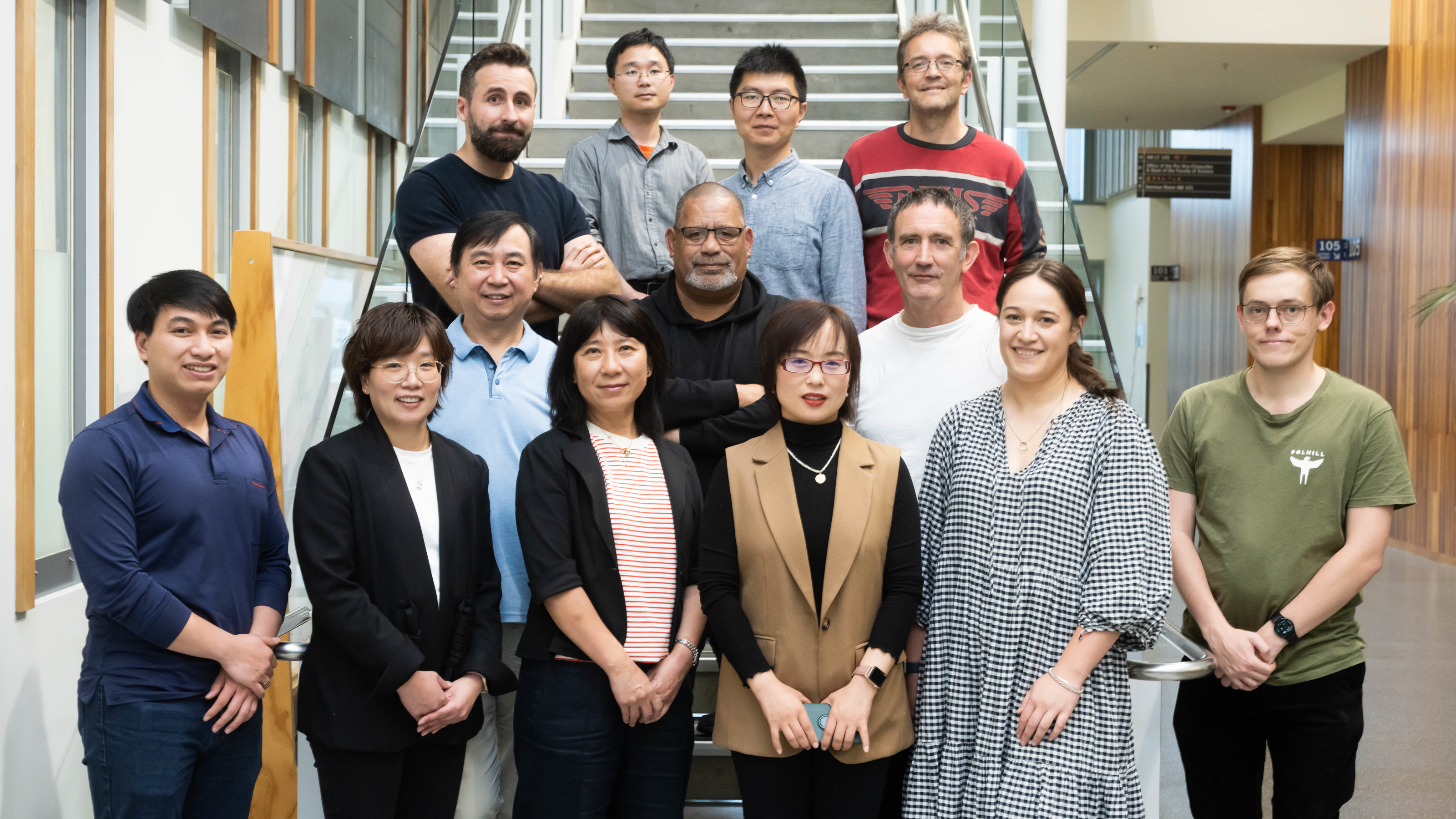
Established in 2023, the CDSAI is Aotearoa’s largest data science and AI research group, and is recognised as among the world’s best in a number of crucial aspects of AI. The Centre works with partners across the University and externally to bring together expertise and innovation in artifical intelligence, data science, and machine learning.
Through the CDSAI, Te Herenga Waka established Aotearoa’s first postgraduate qualification in AI, and there are currently more than 80 candidates in its PhD programme. Te Herenga Waka was also the first—and remains the only—university in New Zealand to offer an undergraduate major in AI, within the Bachelor of Science.
Alongside teaching and postgraduate supervision, the CDSAI undertakes important fundamental research and develops real-world projects for a range of industries.
Our goal is to bridge theory and application—influencing areas like primary industry, climate change, health outcomes, and high-tech and high-value manufacturing—and ultimately contribute to positive changes in the economy, environment, wellbeing, and society.
Professor Mengjie Zhang
Director, Centre of Data Science and Artificial Intelligence
Applying AI theory to the real world
Meng says one of the CDSAI’s priorities is finding ways AI can be used to solve intractable real-world problems, and it has received significant amounts of external funding to do so. As well as collaborations with almost all faculties at Te Herenga Waka, the Centre is also working with New Zealand’s Public Research Organisations (PROs), government agencies, and independent science organisations. Internationally, it’s partnering on research with high-tech companies like Google, and with researchers at universities around the world.
Meng says the CDSAI’s research is about discovering and developing entirely new AI algorithms and methods, as well as applying existing AI techniques to different uses.
Economically, New Zealand relies heavily on its primary industries, so the CDSAI is developing data science and AI tools to optimise processes in domains like aquaculture, agriculture, horticulture, and food safety.
Researchers from the Centre are also applying data science and developing AI technologies to track changes in the environment and respond to climate change.
The CDSAI is helping improve people’s wellbeing by applying artificial intelligence and machine learning methodologies to the health and biomedical science industries—the tools being developed can substantially improve the speed and accuracy of things like cancer detection, medical diagnosis, and drug discovery.
AI and machine learning tools are also highly valued by the security, energy and high-tech manufacturing sectors, with important applications in areas like sectors like cybersecurity, sustainable and renewable energy, and transportation.

Minimising AI’s negative impacts
AI is already being used for things like economic and financial modelling, banking, insurance, and human resources, but these uses have serious ethical implications.
While most people realise the importance and potential good of AI, there are also some people who worry about the negative aspects or are even afraid of AI.
Professor Mengjie Zhang
Director, Centre of Data Science and Artificial Intelligence
“In New Zealand, the percentage of people with concerns about its negative aspects is higher than in many other countries. So we are providing advice to the government because it’s important they are making good regulations and policies around AI that bring the negative impacts to a lower or minimum level,” explains Meng.
Among the world’s best in AI research
The CDSAI is recognised on a global scale as one of the best AI research organisations in the world for automated design and learning of deep neural network architectures—in terms of research papers published on that topic, the Centre is ranked second internationally, just behind Google.
Another strength of the CDSAI is in image, language and signal processing—it’s a research area in which Professor Bastiaan Kleijn is very well known, having developed and sold key signal processing communication techniques to Skype. He continues to work with some of the world’s biggest technology companies, including Google.
Meng himself is regarded internationally as a leading researcher on evolutionary machine learning, and is regularly invited to speak on the topic at international computational intelligence research events. His work is very highly cited, and he has been recognised as Highly-Ranked Scholar, along with his colleague Professor Bing Xue. Among his other research, Meng is currently co-editing a book series with two American professors on Genetic and Evolutionary Computation.
The leadership and impressive research output by Meng and his team has contributed to Te Herenga Waka’s high international rankings in AI research fields, including first in Genetic Programming, fourth in evolutionary computation, and ninth in Particle Swarm Optimisation.
The CDSAI plays an important leadership role on an international scale—it has hosted several big international conferences on AI. In 2019, around 600 experts converged on Wellington for the IEEE Congress on Evolutionary Computation, and in 2025 the CDSAI hosted the Pacific Rim International Conference on AI (PRICAI).
The future of AI
Meng believes the breakneck speed at which AI has been advancing won’t slow down any time soon.
“The applications of AI will become even broader over the next few years—if you compare how it’s used today with just five years ago you can see how far AI has come. AI will reach into almost every major industry and aspect of our daily life to an even greater extent than it already does—here at the CDSAI, we’re focused on how to make sure AI serves society in the best ways possible.”
Find out more about research at Te Whiri Kawe Centre for Data Science and Artificial Intelligence